DOES YOUR MEDICINE WORK?
Scroll
Sound familiar?
Questions
with no answer
- My doctor prescribed several medicines. Which of them actually work?
- Grandma has treated every cold with the same medicine all her life. Does it really help?
- The pharmacist recommended something for immunity. Is it worth the money?
- I saw an ad for a new anxiety medicine. Should I try it?
- I found a medicine online with tons of great reviews. Does it really work that well?
- I want to prescribe my patient a medicine with proven efficacy. Where can I check?
- Mom says to spray a medicine from the fridge up my nose — it will kill every virus. Is that true?
- A video says to put propolis on cuts so they heal faster. Is there any proof?
- A friend’s doctor prescribed her a medicine, and she offers it to me. Maybe it will help?
- The pharmacy is out of the substance on my prescription and offers another one. Should I agree?
Have you ever wished you could be sure of every medicine you take?
To know it really works.
That there’s evidence behind the promises.
That you choose with your eyes open, not blindly.
Pillario
An app that checks how effective medicines are.
How it works
From package
to answer
-
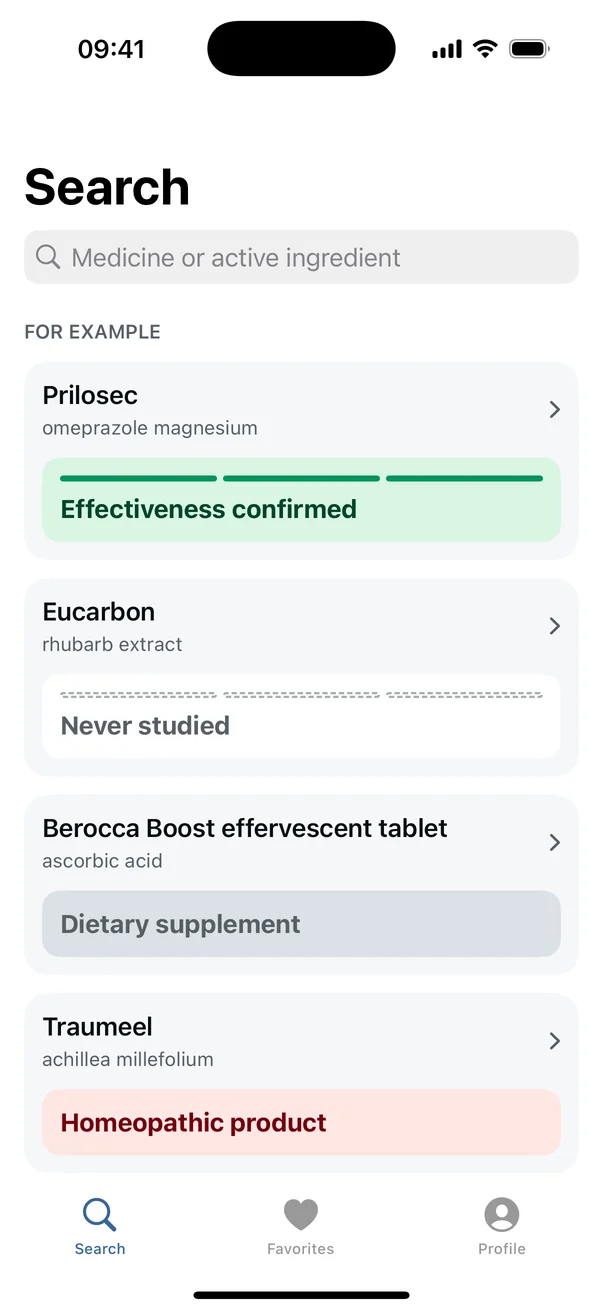
Type the name
Brand name or active ingredient, exactly as printed on the package or the prescription.
-
See what you’re holding
Medicine, supplement or homeopathy — the type shows at once. A medicine gets an assessment of its active ingredient; the other two get none, and the card says why.
-
See what the assessment rests on
Three criteria: a regulator approved it, the WHO put it on its essential medicines list, HAS (France) confirmed its benefit. The count sets the level, from “Strong evidence” to “Never studied.”
-
Verify it at the source
The FDA page, the EMA decision, the review in the Cochrane Library — one tap from the card. Check the conclusion yourself instead of taking our word for it.
How the assessment works
How well proven?
Not a score or a percentage. Three questions: did a regulator approve it, is the substance on the WHO essential medicines list, did HAS confirm its benefit. The number of “yes” answers sets the level, and the card shows what’s behind it.
Criteria
Strong evidence
3 of 3 criteria
All three criteria agree.
Levels
- Strong evidenceThree criteria
- Moderate evidenceTwo criteria
- Weak evidenceOne criterion
- Not confirmedNone, but it was studied
- Never studiedNo research anywhere
In the app
What you’ll see on the card
-
Warnings come first
Withdrawn from the US market, refused by the EMA, rated insufficient by HAS, or taken off sale — it’s stated at the top of any card, with a link to the decision.
-
The source, one tap away
Not the regulator’s home page but the record itself: the medicine’s FDA page, the EMA decision, the exact Cochrane review. It opens inside the app — nothing to search for.
-
No assessment? You’ll see why
Supplements are registered without any effectiveness check, so there’s no assessment — the card says so. Homeopathy hasn’t been shown to work for any condition, and a popular 30C dilution holds not one molecule of the substance.
More likely than finding a single molecule of the substance in a 30C dilution: toss a coin a hundred times — and get heads all hundred times.
-
Search your country’s registry
Type the name on the package — Pillario finds it among the medicines of your country. Country from your iPhone region or your pick: Russia, Kazakhstan, Belarus, the UK, the US, Canada, Japan, Australia, the EU and EEA.
-
Searches aren’t stored
Search goes through the Pillario server, but it doesn’t record your queries or your IP address. No name, email or Apple ID on file — and no sign-up. Favorites and history live on the phone and, with iCloud, on all your iPhones.
-
Data stays current
Sources are recalculated regularly, and the card reloads every time you open it — you see the current regulator decisions and the latest reviews, not a snapshot from a year ago.
Sources
How do you know that?
Three kinds of sources: who approved it, who recommends it, who studied it. Each tile on the card opens and links to the original record.
- RegulatorFDAUS: approved, not on file or refused — and the list of withdrawn drugs
- RegulatorEMAEU: authorization valid across the Union, a refusal, or no record
- RegulatorHealth CanadaCanada: whether Health Canada authorized it
- RegulatorPMDA (Japan)Japan: whether PMDA approved it
- RegulatorTGAAustralia: whether it’s registered with the TGA
- ExpertsWHOEssential medicines for adults and for children; antibiotics by AWaRe class
- ExpertsHASFrance’s benefit rating, from major to insufficient
- ResearchCochraneSystematic reviews: how many and what they found
- ResearchEpistemonikosHow many systematic reviews of the substance exist worldwide
- ResearchPubMedMeta-analyses and randomized trials
- ResearchClinicalTrials.govCompleted trials and how many have posted results
Bring sources to your doctor
Sources, right at the appointment
Pillario helps you discuss your prescribed medicines with your doctor right at the appointment. Diagnosis and prescriptions are your doctor’s call.
A patient asks about a medicine — open its card: whether regulators approved it, whether it is on the WHO list, what high-quality studies found. Every conclusion links to its primary source.
Pillario is a reference. Don’t stop or change your treatment without consulting your doctor.
Pillario is a reference, not clinical guidelines. Treatment decisions are yours.
Choose your medicines with your eyes open
Find out in seconds whether your medicine’s effectiveness is confirmed — with a source behind every conclusion. No sign-up: download it and check the first medicine in your cabinet.